
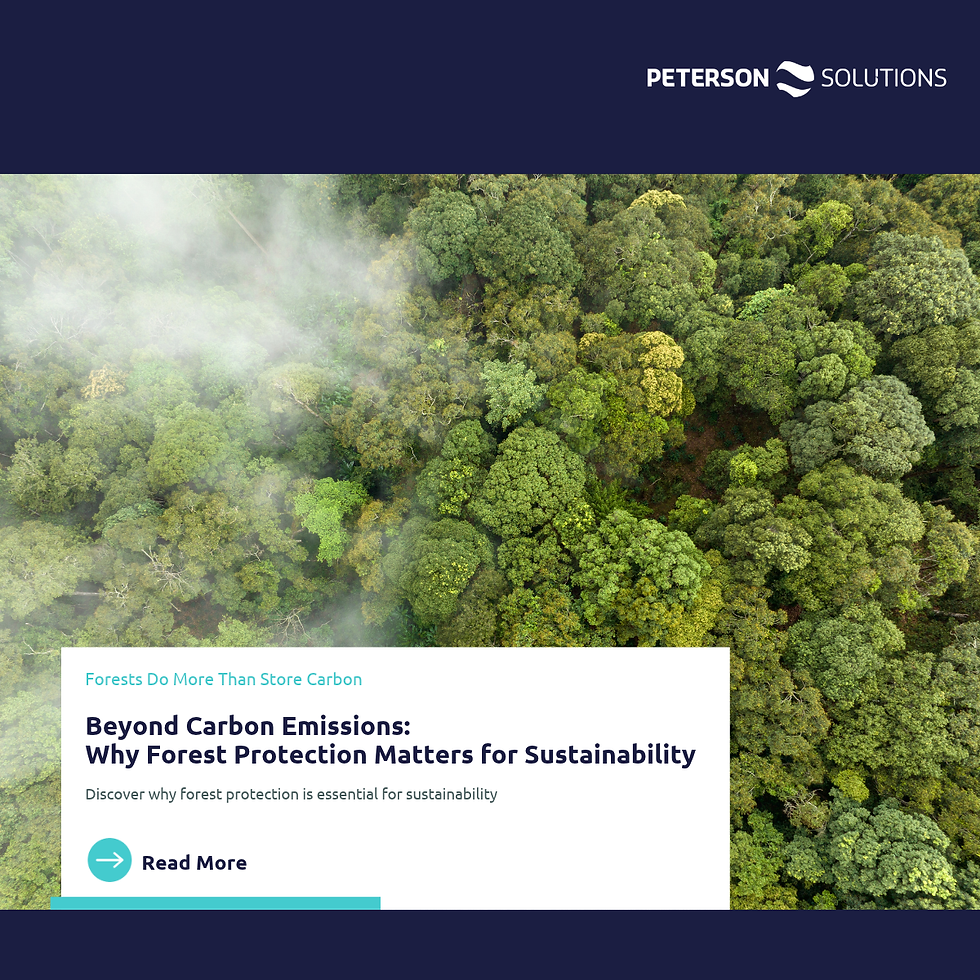
Beyond Carbon Emissions: Why Forest Protection Matters for Sustainability
When businesses discuss sustainability, carbon emissions often take centre stage. Companies increasingly measure their greenhouse gas emissions, set climate targets, and explore ways to reduce their environmental footprint. However, addressing climate change requires more than reducing emissions alone.
Forests play a fundamental role in maintaining the balance of natural ecosystems. They absorb and store carbon, support biodiversity, regulate water cycles, center protect soil, and sustain the livelihoods of millions of people. When forests are degraded or destroyed, these interconnected environmental and social benefits are also threatened.
For businesses, forest protection is not simply an environmental concern. It is closely linked to climate resilience, responsible sourcing, supply chain transparency, and long-term business sustainability. Understanding the connection between forests and sustainability is an important step towards building a more comprehensive approach to environmental responsibility.
1. Forests Do More Than Store Carbon
Forests are widely recognised for their role in absorbing carbon dioxide from the atmosphere. Through photosynthesis, trees absorb carbon and store it in their trunks, branches, roots, and surrounding soils. This makes forests an important component of global climate regulation.
However, their contribution extends far beyond carbon storage.
Healthy forests provide habitats for wildlife, maintain soil stability, regulate water flows, and support the natural processes that sustain agriculture and other economic activities. Forest ecosystems also help regulate local temperatures and influence rainfall patterns. When forests are cleared or degraded, these functions can be disrupted. Deforestation can release stored carbon, reduce the capacity of ecosystems to absorb future emissions, and increase pressure on biodiversity and water resources. This is why climate strategies that focus exclusively on emissions reduction may overlook other environmental risks.
Forest protection should therefore be considered an integral part of a broader sustainability strategy, alongside decarbonisation, biodiversity conservation, and responsible resource management.
2. Biodiversity Loss Is a Business and Environmental Risk
Forests are among the world's most important ecosystems for biodiversity. They provide food, shelter, and breeding grounds for countless species, including plants, animals, fungi, and microorganisms. Forest degradation and habitat loss can disrupt ecological relationships and threaten species survival. These impacts can extend beyond wildlife, affecting the ecosystem services that people and businesses depend on.
For example, agricultural production may depend on pollination, healthy soils, reliable water supplies, and natural pest regulation. Changes to surrounding ecosystems can undermine these functions and create additional challenges for farmers and agricultural supply chains.
Businesses operating in forestry, agriculture, food production, and commodity trading may be particularly exposed to these risks. Protecting forests and their biodiversity can help maintain ecosystem functions, support more resilient production systems, and reduce the environmental impacts associated with land use.
For businesses, this means that biodiversity considerations should not be separated from climate action or supply chain management. They are interconnected elements of a responsible sustainability approach.
3. Forest Protection Strengthens Supply Chain Resilience
Deforestation can pose significant challenges for companies that rely on agricultural and forest-based commodities. Palm oil, timber, paper, coffee, cocoa, rubber, and other commodities may be linked to land-use change and deforestation risks, depending on how and where they are produced. As buyers, regulators, investors, and consumers increasingly scrutinize environmental practices, businesses may face growing expectations to demonstrate the origins of their raw materials and how they are produced. Limited visibility into sourcing locations can make it difficult to identify environmental risks, verify supplier information, and demonstrate compliance with applicable requirements.
A more transparent supply chain can help businesses identify these risks earlier and make more informed sourcing decisions.
Practical measures include:
Mapping suppliers and sourcing locations.
Improving traceability of raw materials.
Assessing deforestation and land-use risks.
Strengthening supplier due diligence.
Maintaining reliable documentation and verification records.
Engaging suppliers and smallholders to improve environmental practices.
These measures can help companies improve supply chain visibility and support responsible sourcing.
Forest protection is therefore not only about conserving natural ecosystems. It is also about strengthening the resilience and credibility of the supply chains that businesses depend on.
4. The Role of Forest Protection in Climate Resilience
Forests contribute to climate resilience by helping regulate water cycles, stabilise soils, and reduce certain environmental risks. Forest vegetation can intercept rainfall, while roots help bind soil and support its structure. Depending on the landscape and local conditions, healthy forest ecosystems can help reduce soil erosion, regulate water flows, and protect watersheds. When forests are degraded, landscapes may become more vulnerable to erosion, sedimentation, and disruptions to water availability. The severity of these impacts depends on factors such as topography, soil characteristics, rainfall intensity, and land management practices.
These changes can have consequences for agricultural production, infrastructure, water-dependent industries, and surrounding communities. As extreme weather events and climate-related disruptions become important considerations for businesses, protecting natural ecosystems can be part of a broader climate adaptation strategy. However, forest protection is not a substitute for reducing greenhouse gas emissions. Both actions are necessary to address different dimensions of the climate challenge.
Companies should therefore consider forests within their broader environmental risk assessments, alongside emissions reduction, water stewardship, and climate adaptation planning.
5. Deforestation Regulations and Responsible Business Practices
Forest protection is also increasingly relevant to international trade and corporate supply chain management. One important example is the European Union Deforestation Regulation (EUDR), which sets requirements for covered commodities and certain derived products placed on the EU market or exported from it. The regulation addresses commodities including cattle, cocoa, coffee, oil palm, rubber, soya, and wood, as well as specified products derived from them.
Depending on the applicable requirements, relevant operators and traders may need to demonstrate that covered products meet the regulation's deforestation-free criteria, comply with relevant legislation in the country of production, and are supported by the required due diligence information.
For businesses connected to Indonesian agricultural and forestry supply chains, understanding the regulation's scope and applicable implementation dates is important.
Preparing for deforestation-related requirements may involve:
Identifying products and commodities within the regulation's scope.
Mapping relevant suppliers and production locations.
Collecting and verifying geolocation information where required.
Assessing deforestation and legality risks.
Establishing appropriate due diligence procedures.
Maintaining supporting information and documentation.
It is important to distinguish regulatory compliance from voluntary sustainability certification. Certification can support certain sourcing and assurance processes, but it does not automatically replace the legal obligations applicable under EUDR or other regulations.
Beyond compliance, stronger traceability and responsible sourcing practices can help businesses respond to customer expectations and improve their understanding of environmental risks throughout their supply chains.
6. Moving Towards Nature-Positive Business Practices
Traditional corporate climate strategies often focus on measuring emissions and reducing carbon intensity. While these actions remain essential, a more comprehensive sustainability approach also considers how business activities affect nature. This is where the concept of nature-positive business becomes relevant.
A nature-positive approach seeks to halt and reverse the loss of nature, including biodiversity and ecosystem integrity. In practice, this requires businesses to understand their impacts and dependencies on natural ecosystems and take credible action to address material risks.
For companies with land-intensive operations or commodity-based supply chains, this may involve:
Assessing nature-related impacts and dependencies
Identify how business activities interact with forests, biodiversity, soil, and water resources.
Preventing deforestation and ecosystem conversion
Establish responsible sourcing policies and appropriate controls to avoid sourcing from prohibited or high-risk areas.
Improving supply chain transparency
Use traceability systems and supplier assessments to improve visibility over sourcing locations and production practices.
Supporting restoration and conservation
Where appropriate, work with credible partners and local stakeholders to support ecosystem restoration and forest conservation initiatives.
Monitoring and reporting progress
Establish measurable indicators and maintain reliable evidence of environmental performance.
These actions should be based on credible data, appropriate safeguards, and measurable outcomes rather than broad environmental claims.
Nature-positive business practices can help organisations move beyond isolated environmental initiatives towards a more integrated approach to sustainability.
7. What Businesses Can Do to Support Forest Protection
Businesses do not need to wait for a major regulatory change to begin addressing deforestation risks. They can start by understanding their environmental impacts and the origins of the materials they use.
The following steps provide a practical starting point.
Step 1: Identify exposure to deforestation risks
Review products, raw materials, sourcing regions, and business activities that may be associated with deforestation or ecosystem conversion.
Step 2: Assess suppliers and sourcing locations
Gather relevant supplier information and evaluate environmental risks throughout the supply chain.
Step 3: Strengthen traceability and documentation
Establish systems to record sourcing information, verify relevant claims, and maintain supporting evidence.
Step 4: Integrate forest protection into sustainability policies
Connect responsible sourcing commitments with procurement procedures, supplier engagement, risk management, and environmental objectives.
Step 5: Monitor performance and improve continuously
Review supplier data, assess progress against defined objectives, and update risk management measures as circumstances change.
The right approach depends on the company's industry, supply chain structure, regulatory exposure, and sustainability priorities. By integrating forest protection into everyday business decisions, companies can take a more proactive approach to managing environmental risks and supporting responsible production.
Sustainability Must Go Beyond Carbon
Reducing greenhouse gas emissions remains essential to addressing climate change. However, long-term sustainability also depends on protecting the natural ecosystems that support biodiversity, water security, soil health, and human livelihoods.
Forests are central to this effort. Protecting them can help mitigate climate change, strengthen ecosystem resilience, and support more responsible supply chains.
For businesses, the challenge is to translate these environmental priorities into practical action through better risk assessment, transparent sourcing, effective traceability, and credible sustainability commitments.
A comprehensive sustainability strategy should not only ask how much carbon a business emits, but also how its activities affect the natural systems on which its future depends.
At Peterson Solutions Indonesia, understanding the relationship between environmental responsibility, supply chain transparency, and evolving sustainability requirements can help businesses take informed steps towards more responsible operations.


Comments